A few days ago, we successfully completed our bike and car journey. Chris and I are both very happy that the trip was a lot of fun. We both had a great time. And most importantly, the trip was a safe one. This blog post describes the last day of riding and outlines the efforts I made to enhance ride safety.
Chris and I made it! And we had a lot of fun along the way.
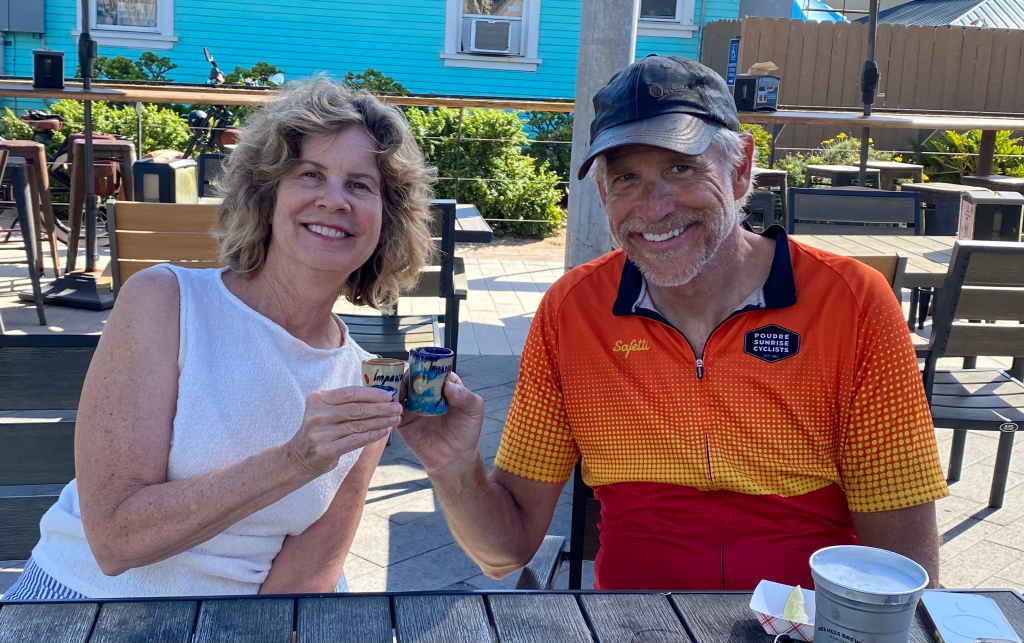
After the ride, Rich and I each did a shot of tequila, drank a beer, and the three of us ate a late lunch. Chris and I took Rich to the Amtrak station for his journey back to L.A. Thanks a lot for coming along, Rich. Your company and experience over the last few days were invaluable.
After that, Chris and I immediately hopped on the road back to Fort Collins. We have been gone for almost 6 weeks. During the trip, we didn’t miss home at all. But now that the vacation is over, we wanted to get back to our own beds. We stopped for lunch with Judy in Arizona, but otherwise, it was 20+ hours of driving. Ugh!
Riding
Day 34: 45 miles, 1647 elevation
The last day of riding was pretty easy. My friend Rich was with me on this day, and it was great to have his company and his experience. He used to live in San Diego and regularly rode major sections of the route that is today’s ride.
This ride mostly followed the coast, passing through many Southern California beach towns. It also included a ride through San Diego, featuring a road right next to the airport, as well as a ferry ride. It is not easy or safe to get close to the U.S.-Mexico border in the same way we did the U.S.-Canada border. So we opted to ride to the Imperial Beach pier, a couple of miles north of the border. It was a pleasant place to finish up. Chris got there early and took a video of us riding in (see below). Chris also found a nice craft brewery where we could celebrate while still keeping an eye on the bikes.
Staying Safe While Biking the Pacific Coast
If you have been reading along with the blog, you know that safety was a primary concern. I had friends who were interested in the ride but concerned about safety. Others who have done parts of this route warned me of hazards. Compared to my ride across the country a few years ago, this route has places with significant traffic and many roads and bridges with narrow shoulders. Chris, my SAG, only wanted me to ride it if she had the power to tell me to put the bike on the back of her car for the next segment—and that happened a couple of times.
I gave a lot of thought to staying safe before, during, and after the ride. I want to share some of my experiences, to provide advice to others who might take on this or other tours. Also, so that other readers might share their own ideas in the comments. I have organized my ideas below.
This is a deep dive, probably too much information for most of my readers. That said, I am hoping that future Pacific Coast riders see this post and get some new ideas. It is written so you can skim bullet points if you just want the gist of this.
Plan before the ride
There are many things you can do before you get started. These include:
-
Route selection. Where possible, choose roads with lighter traffic, shoulders, or bike lanes. Better yet, find bike paths. Fortunately, the Adventure Cycling Association (ACA) does just that, and sells maps of dozens of routes, including the Pacific Coast route. The maps take you off major roadways where possible and include warnings where needed. The organization has also lobbied for signage and other safety features on these routes.
-
Study the route. Two resources helped me learn the route. The first was the set of paper maps I bought from the ACA. These detailed maps give a lot of information. The second was the Facebook group, the Pacific Coast Bike Route, which regularly features posts from people who are doing or have done this same trip. These folks warned me of particular areas that they viewed as more dangerous. They also suggested getting on the road early, as tourist traffic often picked up after about 10 or 11 in the morning.
-
Get second opinions. It helps to have friends who have previously been on the route. My friend Bob had ridden the Oregon part of the trail and offered advice before I left. My friend Rich rode the last three days with me and knew those roads from rides he had done. I previously posted on how I used AI to help me plan this trip. I used three AI tools to gather their opinions and insights about each day of my proposed itinerary. The AI was fairly accurate and reliable, and provided a useful piece of input.
-
Daily distance and stops. I planned my route to anticipate where I would find services each day, allowing me to pack extra water or food if needed. This was generally less of an issue on this route, as cities, towns, or stores were never more than 15-20 miles down the road.
-
When to ride. I planned this ride for September and October because I had read that it was much safer during those months. Along this route, the summer sees increased traffic and more inexperienced drivers operating large RVs. This time of year also has the best weather.
-
Weather awareness. I checked the weather every day, with special attention to wind, temperatures, and rain. I was fortunate that none of those factors became a significant issue on this trip.
-
Backup plans. I ensured I was aware of when and where problems would arise. The ACA provides updates and corrections to their maps, and the Facebook group has the latest information. For example, I was well aware that the route had a road closure and a major detour around Big Sur. I also learned of alternative (safer) routes in Pacifica and Watsonville. My best backup plan was Chris, who was never too far away.
Get the support of other folks
-
A SAG. Having Chris along on this ride was extremely helpful. As mentioned, there were a couple of times when she picked me up, and I avoided riding through a more dangerous part of the route. I am not sure what I would have done if she hadn’t been there on that foggy day. By the time I realized the danger, the only options were to wait it out or press ahead. In this case, she picked me up. She often drove ahead of me, warning me of upcoming segments with narrow shoulders and heavy traffic.
-
Prayer. I heard that some of my friends and relatives are were praying for me. I appreciate that. Thank you.
Be seen on the bike
-
High visibility clothing. When I rode across country, a woman in Kentucky came up to me at a convenience store and thanked me for wearing the brightly colored Poudre Sunrise Cyclists jersey. I have two of those and a bright yellow jersey that I wore exclusively on this trip.
-
Bright, blinking lights. I use bright blinking lights on my bike and helmet. I add one to my helmet for touring rides. There is also a headlight. I think it helps if cars on the other side of the road know a cyclist is approaching; they may move a bit to the side so that if a car passes me as they approach (I hate when they do that), there will be enough room for all three of us.
-
Positioning on the road. When I am on a busy road, I ride very strategically. When the shoulder is wide, I simply ride as far from traffic as I can get. When the shoulder is narrow or nonexistent (not uncommon on this trip), I play some games. If my car is approaching from behind, even when it’s still far away, I might signal to the driver that I am a bit erratic and unpredictable. For example, I might bounce a bit more into the lane. If they see this from a distance, they slow down because they are unsure if they can safely pass me. When the car gets closer, I tuck myself closer to the shoulder. At other times, I clearly “take the lane” and ride down the middle of the lane. Signage on this route often warned drivers that cyclists could do that. It discourages drivers from trying to squeeze past you, and they make the pass only when they clearly have access to the other lane of traffic.
Use technology and gear for safety
-
Radar systems. One of my taillights is the Garmin Varia, which has a radar system. When a car is 150 yards back, the system signals to my bike computer. I get a beep from the bike computer, and a red dot appears on the right side of the screen. Very helpful.
-
Mirror. I use a rear-view mirror that attaches to my glasses. This allows me to always see what is behind me.
-
Bike setup. My bike was checked out before I left by my friends at Brave New Wheel (bike shop in town). I also checked in with a few bike shops along the way. I brought extra tires and swapped one of them out about halfway through the trip.
-
Navigation devices. The bike computer, which I had to replace during the ride, is my best friend. I like the data it provides, but it also gives me navigation, so I know when to turn without stopping to look at paper maps or my phone (though I often referred to them as well).
On-the-bike practices
-
Defensive riding. I always assume that drivers can not see me. I try to ride predictably (except, as noted above, when they approach from behind and need a nudge to slow down). I signal my turns. And, if I feel unsafe, I stop and pull over. I did that a couple of times.
-
Manage climbs and descents. Of course, I ride slower when I climb, although when shoulders are narrow and cars are backed up behind me, I often try to ride harder. Fast descents can be fun, but also dangerous; I had my share of “whees,” but there were a lot of times when descending safely meant slowing down by using my brakes.
-
Hydration and nutrition. Staying alert is easier when you are properly fueled.
-
Breaks. I make more mistakes when I’m tired, so I rest where necessary.
-
Using AirPods only when safe. This is a controversial topic. Some riders believe it is never safe to use earbuds while riding. I really enjoy listening to books and podcasts when I ride. On this trip, because each mile was new to me, I was more judicious in my use of AirPods. In the first half of the journey, I mostly rode roads where I felt safe, using them regularly. I took them out for the Avenue of the Giants just because it was such an awe-inspiring segment of the ride. After that, I felt more at risk and rarely used my AirPods in the second half of the ride.
Mindset and habits
-
Patience over speed. I choose safety when traffic or conditions are risky.
-
Awareness. I constantly scan for hazards (cars, wildlife, road debris).
-
Communication. Wave or make eye contact with drivers to ensure they’ve seen you.
-
Trusting instincts. If something feels unsafe, change the route or take a pause.
Obviously, I am happy there were no incidents along the whole ride. The “close calls” were occasional drivers who passed me tighter than I might like. Some of staying safe is just good luck. But I feel you can significantly improve your odds by doing some of the things noted above.
What has Chris been doing?
These last few days were really helpful for Chris, in thinking about Ally and Mack’s wedding next summer. Being right there to see the venue and help Ally figure things out was helpful in that regard. Chris also scouted ahead of Rich and I on the last day.
From there, Chris and I were both doing a lot of driving. We are now home safe and sound, catching up on the mail, the house, the yard, and soon, with friends.
What’s next?
I feel like I have one or two more blog posts in me. I hope to post those in the next week or so. While riding, I have plenty of time to think. Some of my thinking was to answer questions about why I do this: Why do I so enjoy riding my bike? Why do I like to do these long adventure touring rides? I have some thoughts to share on that.

 JoeRides.blog
Leave a comment